
Why i belong to circular indiana
Updated: Apr 7
As a “do-it-yourself” person, it is always a great and rewarding feeling to find a specific tool or solution that allows me to fix something or to resolve problematic situations. Similarly, this describes how I felt as I learned about the concept of a Circular Economy.
recognizing the common causes
When I think about the negative impact that humanity has on the sustainability of our planet and about what lies ahead for my children and grandchildren it is alarming to me. Our planet—and its people—are facing existential risks arising simultaneously and all are occurring over a short period compared to the evolutionary time scale of our resilient planet:
Climate change
Deforestation
Species extinction
Ocean acidification
Soil degradation
Health impacts from man-made pollutants like PFAS and microplastics
Many dedicated organizations are confronting each of these serious issues, yet they all continue to escalate. Wouldn’t it be incredible if we could recognize common root causes for these multiple planetary threats and a common framework to solve them?
Waste & Consumption: the Root Cause
Climate change is the most recognized planetary challenge we face. At its core, climate change is driven by the accumulation of carbon dioxide (CO2) waste in the atmosphere. This waste disrupts natural climate patterns across the planet and is primarily the result of our continued consumption of fossil fuels for energy. Species extinction can be tied to habitat loss caused in part by food waste and the growing consumption of animal protein. The health impact of man-made pollutants in our water, air and food is likewise caused by excessive consumption of technically complex products and by low cost and convenient waste disposal practices at end-of-use. Clearly, consumption and waste are two recurring root causes.

The Solution: The Circular Economy
There is also a root cause factor more basic than waste and consumption, our prevailing economy itself. The economy is often described as the resources and wealth of a nation resulting in the production and consumption of products and services. It also refers to how societies manage scarce resources.
When the economy is a linear process of extracting raw materials, making products, consuming those products and disposing of them as waste, the material assets used are lost forever, and the waste causes the issues highlighted above.
Alternatively, in a circular process the making, consuming and recovery of resources at end-of-use becomes a continuous loop. Consumers are transformed into users; waste is eliminated and materials are recovered to initiate another cycle.

Changing to a circular economy provides a process to address many of humanity’s greatest planetary threats and enables the natural world to recover.
“Re”s to the Rescue
How can we change something as complex as the economy? There are many “Re” cycles required within a
circular economy:
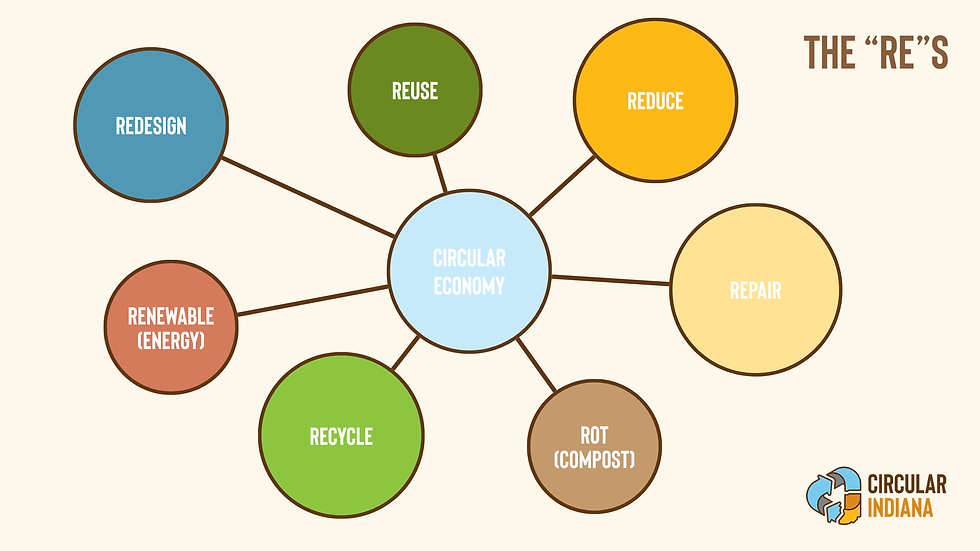
The “Re”s work together with a strong sense of personal responsibility and respect for materials to transform today’s consumers into wise users and to redesign products for a circular process. In doing so, society can address multiple planetary issues and achieve a sustainable economic future.
The Linear Economy has given us many products that I would never want to give up, but unfortunately it depends on perpetual economic growth and endless consumption of resources, an approach our planet cannot sustain. It is said that the linear economy is like a plane that continuously rises. But just as every plane will ultimately exhaust its finite fuel, our planet’s finite resources will also be exhausted. The strain of material scarcity is already being felt and leads to global conflict and social injustice.
Circularity and Indiana
Changing to a circular economy is not going to be easy or convenient, and it will take generations to fully achieve. However, I deeply believe the potential for a more prosperous Indiana and for the security of future generations is within reach, but we must take meaningful individual and societal actions toward circularity now.
Circular Indiana is the only organization in Indiana that focuses exclusively on transforming into a circular economy, and that is why I am an enthusiastic member and encourage others to join us in this mission.
References
International Energy Agency, Energy Mix, 2023; https://www.iea.org/world/energy-mix
UNDP, Chemicals and Waste Hub; https://www.undp.org/chemicals-waste/our-work-areas/plastic-pollution
UNEP, Food Waste Index Report, 2024; https://www.unep.org/resources/publication/food-waste-index-report-2024

Comments